High-Functioning Depression: When You’re Getting Things Done but Still Don’t Feel Like Yourself
You get up in the morning. You go to work. You answer emails, take care of your family, pay the bills, keep appointments, and get through your list of responsibilities.
From the outside, everything may look fine.
But inside, something feels different.
Maybe you’re exhausted all the time. Things you used to enjoy feel more like obligations. You find yourself going through the motions instead of actually enjoying your life. You may be more irritable, less motivated, or increasingly withdrawn. At the end of the day, you have just enough energy to collapse on the couch and wonder why everything feels so difficult when, technically, you’re still getting everything done.
People sometimes describe this experience as “high-functioning depression.”
What Is High-Functioning Depression?
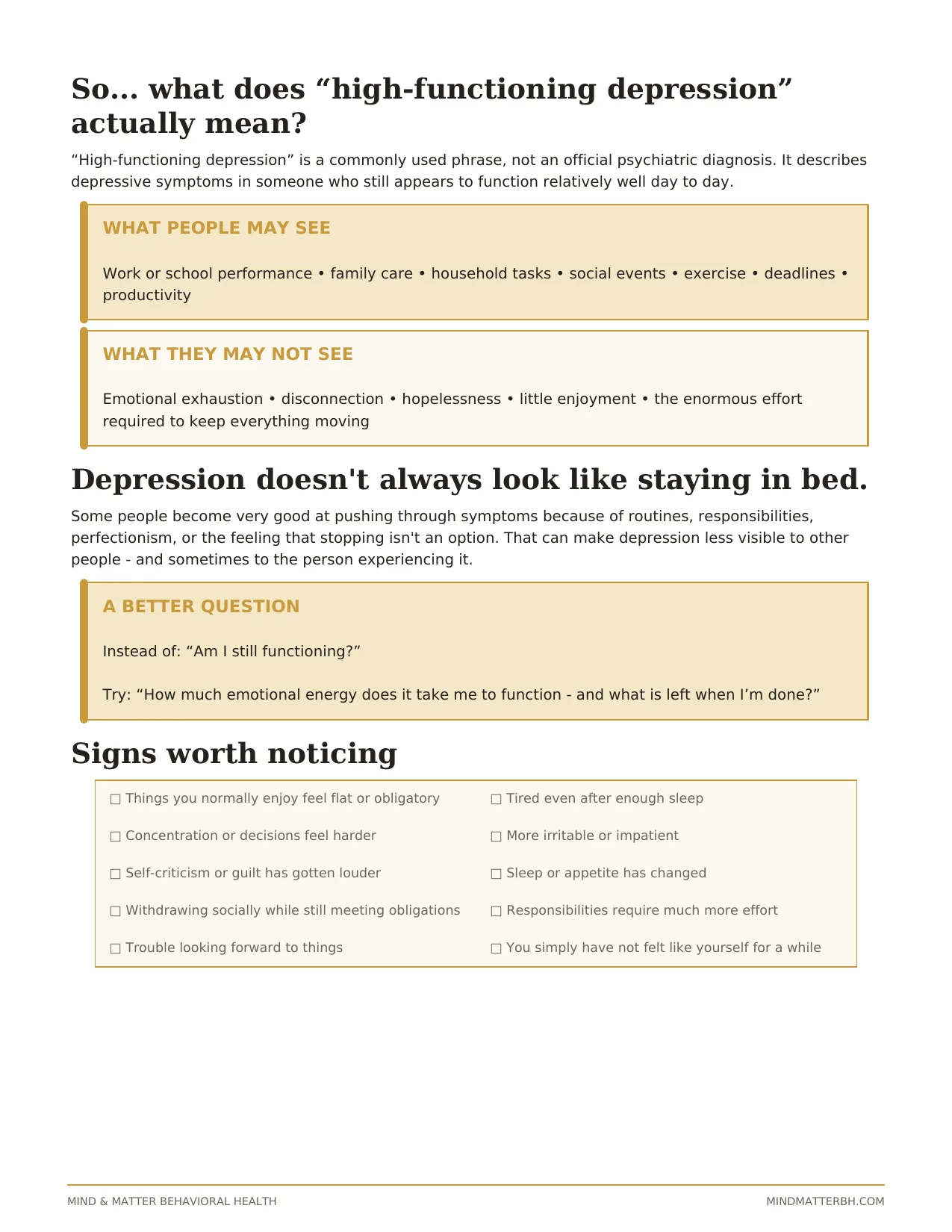
“High-functioning depression” is a commonly used phrase, but it is not an official medical or psychiatric diagnosis.
Instead, it describes a situation in which someone is experiencing symptoms of depression while still appearing to function relatively well in everyday life.
A person may continue to:
- Perform well at work or school
- Take care of children or family members
- Maintain a household
- Attend social events
- Exercise regularly
- Meet deadlines
- Appear successful and productive
At the same time, that person may feel emotionally exhausted, disconnected, hopeless, or unable to enjoy much of what they are accomplishing.
Being productive does not automatically mean you are emotionally well.
Depression Doesn’t Always Look Like Staying in Bed
Many people have a mental picture of depression as someone who cannot get out of bed, stops going to work, or becomes visibly withdrawn.
Depression certainly can look that way.
But it does not always.
Some people become very good at pushing through symptoms. They may have strong routines, significant responsibilities, perfectionistic tendencies, or simply feel that stopping is not an option.
As a result, depression can remain hidden from coworkers, friends, family members—and sometimes even from the person experiencing it.
You may find yourself thinking:
“I’m still functioning, so I can’t really be depressed.”
But the amount you accomplish does not necessarily tell us how much emotional energy it takes to accomplish it.
Signs That Something May Be Wrong
Depression can present differently from person to person, but symptoms may include:
- Losing interest or pleasure in things you normally enjoy
- Feeling persistently sad, empty, numb, or “flat”
- Feeling tired even after getting enough sleep
- Difficulty concentrating or making decisions
- Becoming more irritable or impatient
- Feeling unusually self-critical
- Feeling guilty or believing you are disappointing others
- Sleeping too much or having difficulty sleeping
- Eating significantly more or less than usual
- Withdrawing socially even while continuing to meet obligations
- Feeling that everyday responsibilities require much more effort than they used to
- Having difficulty looking forward to things
- Feeling hopeless about the future
Sometimes the most noticeable symptom is not sadness at all.
It may simply be the feeling that you haven’t felt like yourself for a while.
“But I Have a Good Life. Why Would I Be Depressed?”
This is an extremely common question.
Depression does not require your life to be objectively bad.
A person can have a supportive family, successful career, financial stability, healthy children, good relationships, and many things to be grateful for—and still develop depression.
Mental health conditions are influenced by a combination of biological, psychological, genetic, environmental, medical, and situational factors.
Having things in your life that you appreciate does not make depressive symptoms less real.
And telling yourself that you “should be happy” often adds guilt to an already difficult situation.
Is High-Functioning Depression the Same as Persistent Depressive Disorder?
Not necessarily.
Some people who identify with the term “high-functioning depression” may eventually be diagnosed with persistent depressive disorder, which involves depressive symptoms that continue for a long period of time.
Others may have major depressive disorder, anxiety, chronic stress, burnout, grief, sleep problems, ADHD, a medical condition, medication side effects, or another issue contributing to how they feel.
That is one reason an evaluation can be helpful.
The goal is not simply to attach a label to what you are experiencing. The goal is to understand why you feel different and what can be done to help you feel better.
Sometimes Functioning Comes at a Cost
One of the challenges with hidden depression is that other people may not recognize that you are struggling.
If you continue showing up, meeting deadlines, and taking care of everyone else, people may assume you are doing well.
You may even convince yourself of the same thing.
But maintaining that appearance can require enormous effort.
Perhaps you can perform all day at work but have nothing left for your family at night.
Maybe you can take care of everyone else's needs but consistently neglect your own.
Maybe you still attend social events but spend the entire time wishing you were home.
Or perhaps your life has slowly narrowed to work, responsibilities, sleep, and repeating the cycle the next day.
Functioning is important.
But surviving your responsibilities is not the same thing as enjoying your life.
You Don’t Have to Wait Until Things Get Worse
People sometimes delay seeking help because they believe their symptoms are not “bad enough.”
They may think:
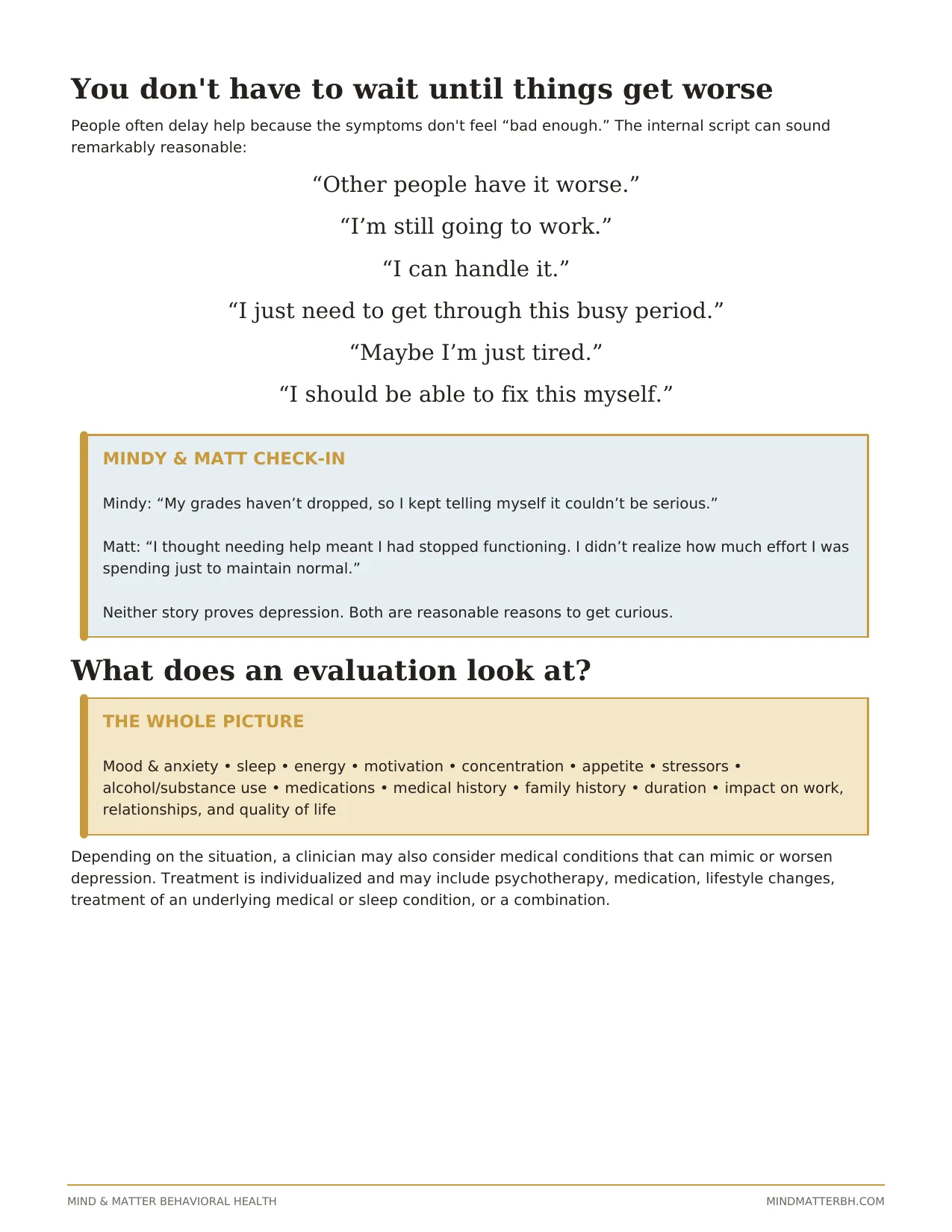
- “Other people have it worse.”
- “I’m still going to work.”
- “I can handle it.”
- “I just need to get through this busy period.”
- “Maybe I’m just tired.”
- “I should be able to fix this myself.”
But you do not have to reach a crisis before talking with someone.
If changes in your mood, motivation, sleep, energy, concentration, or enjoyment of life have persisted—especially for several weeks or longer—it is reasonable to discuss them with a healthcare professional.
What Does an Evaluation Look Like?
An evaluation usually starts with a conversation.
Your healthcare provider may ask about:
- Mood and anxiety
- Sleep
- Energy
- Motivation
- Concentration
- Appetite
- Stressors
- Alcohol or substance use
- Medications
- Medical history
- Family history
- How long your symptoms have been present
- Whether your symptoms are affecting your work, relationships, or quality of life
Depending on the situation, your provider may also consider medical conditions that can mimic or worsen depression.
Treatment is individualized and may include psychotherapy, medication, lifestyle changes, treatment of an underlying medical or sleep condition, or a combination of approaches.
Download the High-Functioning Depression handout (PDF)
Feeling Better Is a Reasonable Goal
If you are accomplishing everything you are “supposed” to accomplish but still feel exhausted, disconnected, irritable, unmotivated, or unlike yourself, it may be worth paying attention to that feeling.
You do not need to prove that you are struggling enough to deserve help.
And treatment is not simply about helping someone continue to function.
The goal is to help you feel better while living your life—not merely become better at pushing through it.
When to Seek Immediate Help
Depression can sometimes include thoughts of death, self-harm, or suicide. If you are experiencing thoughts of harming yourself, feel unable to remain safe, or believe you are in immediate danger, seek emergency help right away.
In the United States, you can call or text 988 to reach the Suicide & Crisis Lifeline. If there is an immediate danger, call 911 or go to the nearest emergency department.
Learn more
This page is educational and is not a diagnosis or a substitute for care. If you are in crisis, call or text 988.